Researched overview.
Table Of Content
Quick answer
Vitamins and minerals matter for hair, but only in one clear way: if you are low in a nutrient, correcting that deficiency can help your hair. If you are not deficient, there is no good evidence that taking extra vitamins makes hair grow faster, thicker or longer.
That is the honest summary of a 2019 review of vitamins and minerals in hair loss (Almohanna et al., Dermatology and Therapy): the evidence is sufficient for correcting a confirmed deficiency, but not for healthy people taking high doses preventively.
So the right order is: eat a varied diet, look for a cause if shedding is new or heavy, test before supplementing, and talk to a clinician or pharmacist before taking any supplement — especially if you are pregnant, breastfeeding, taking medication, or have a medical condition.
This guide is general information, not medical advice.
Contents: How hair grows · Why hair thins · Biotin · Vitamin D · Vitamin E · Vitamin A · Vitamin C · Iron · Zinc · Combinations · Choosing a supplement · When to get help
How hair grows
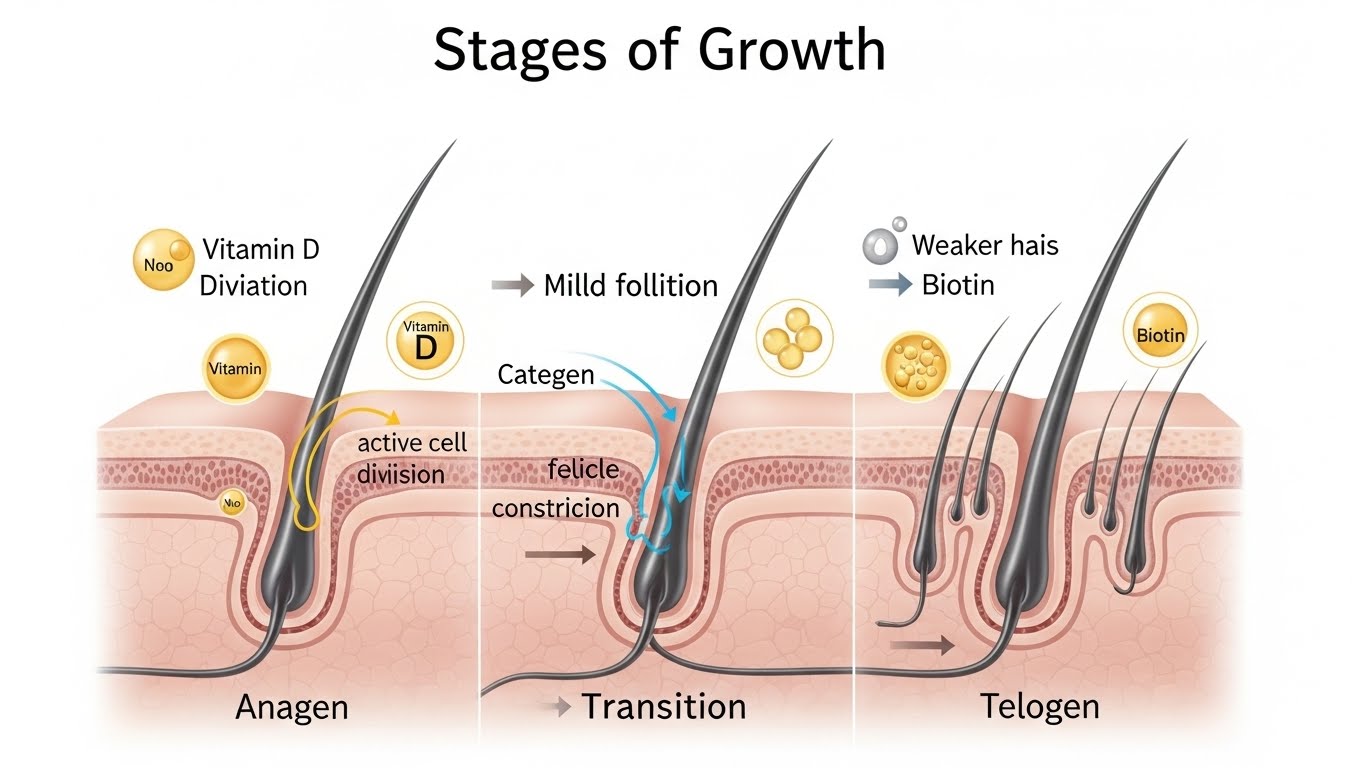
Hair grows in cycles, and every follicle runs its own cycle:
- Anagen — the growth phase. This lasts years on the scalp. It is the phase that decides how long and how thick a hair can get.
- Catagen — a short transition. The follicle stops growing and shrinks slightly. It lasts a couple of weeks.
- Telogen — the resting phase. The old hair rests for around three months, then sheds and a new hair begins.
Normal shedding is 50–100 hairs a day (American Academy of Dermatology). After a trigger such as illness, childbirth, surgery, crash dieting, stress or a new medicine, more hairs than usual can enter the resting phase at once — this is called telogen effluvium. The shedding usually starts 2–3 months after the trigger, and hair tends to regain its normal fullness within 6–9 months once the trigger has passed.
Hair grows slowly — about a centimetre a month. That is why no vitamin, shampoo or remedy can show a visible result in days or weeks, and why any honest timeline is measured in months, with no guarantee.
Why hair thins
Thinning has many causes, and vitamins are only one small part of the picture:
- Pattern hair loss (androgenetic alopecia) — the most common cause of gradual thinning at the hairline or crown. It is driven by genetics and hormones. Vitamins do not reverse it. The treatment with the best evidence for pattern hair loss is topical minoxidil, which is approved by the US Food and Drug Administration for this use; the American Academy of Dermatology says results can take 6–12 months, and it does not work for everyone. Talk to a clinician before starting any hair-loss treatment.
- Shedding after a trigger (telogen effluvium) — see the timing above. It usually settles on its own once the trigger is gone.
- A deficiency — low iron, low vitamin D, low zinc or low biotin can all contribute to shedding. This is the one situation where a supplement can help, and only after a test has shown you are low.
- Tight hairstyles — repeated pulling can cause traction alopecia. Early cases can recover when the tension stops; long-standing traction can permanently damage follicles.
- Illness, thyroid disease and some medicines — these need a clinician, not a supplement.
If your shedding is sudden, patchy, comes with itching, pain, scaling or redness, or has lasted more than six months with no clear trigger, see a clinician before buying anything.
Biotin (vitamin B7)
Biotin is the vitamin most often sold for hair, and the evidence for it is the weakest.
A 2017 review (Patel, Swink & Castelo-Soccio, Skin Appendage Disorders) found 18 reported cases of hair improvement with biotin — and every one of them had an underlying biotin deficiency or a rare hair disorder. There is no randomised controlled trial showing biotin helps people who are not deficient. Biotin deficiency is rare on a normal mixed diet; the adult adequate intake is about 30 micrograms a day (US National Institutes of Health).
The warning that matters: high-dose biotin can interfere with laboratory tests, giving falsely high or falsely low results — including falsely low troponin, the heart-attack test. The US Food and Drug Administration warned about this in 2017 and updated the warning in 2019. Hair supplements commonly contain 5,000–10,000 micrograms — hundreds of times the adequate intake. If you take biotin, tell your clinician and your laboratory before any blood test.
Bottom line: biotin helps only where there is a deficiency. There is no good evidence it thickens hair in people who are not deficient, and high doses carry a real lab-test risk.
Vitamin D
Low vitamin D is associated with some kinds of hair loss — a 2024 systematic review and meta-analysis (81 studies, more than 15,000 people) found lower vitamin D levels in people with alopecia areata and female pattern hair loss. But association is not proof of cause, and there is limited good-quality evidence that vitamin D supplements regrow hair.
Vitamin D does not “activate inactive follicles”. If your level is low, a clinician can test it and advise on food, sunlight and supplements. Do not take high doses on your own — vitamin D is fat-soluble and builds up in the body.
Vitamin E
Vitamin E is an antioxidant, and it is found in seeds, plant oils and nuts. There is no good evidence that vitamin E improves blood flow to the scalp or grows hair.
Vitamin A
Vitamin A is needed for cell growth and for making sebum, the oil that keeps the scalp from drying out. Food sources — sweet potatoes, carrots, leafy greens — supply it safely for most people.
The important fact about vitamin A is the opposite direction: too much vitamin A can cause hair loss. A sustained excess, usually from high-dose retinol supplements or fish liver oils, builds up into hypervitaminosis A, which has a strong recognised link to diffuse shedding (telogen effluvium). The shedding is usually reversible once the excess stops and levels return to normal, but it takes months. The NHS advises keeping long-term intake below an average of 1.5 mg a day. A vitamin A deficiency, by contrast, has no known link to hair loss.
Bottom line: do not take high-dose vitamin A for your hair. It can cause the very problem you are trying to fix.
Vitamin C
Vitamin C is a cofactor for collagen synthesis in the body, and it helps the body absorb iron from food — that is the real link to hair. Citrus fruit, berries and leafy greens are rich sources.
Vitamin C does not build the hair shaft itself: hair is keratin, not collagen, so vitamin C does not “support the structure of the hair” through collagen. A vitamin C deficiency can weaken hair, but it is uncommon where the diet includes fruit and vegetables.
Iron
Iron carries oxygen to the follicles. Iron deficiency can contribute to diffuse, non-scarring hair loss — a 2021 meta-analysis of 36 studies (10,029 participants) found lower average ferritin in women with non-scarring hair loss, though the studies varied widely.
Test first. Do not take iron “just in case”: excess iron can cause harm, and iron supplements are a common cause of accidental poisoning in young children. A ferritin blood test shows whether you are low, and a clinician can advise on food and, if needed, a supplement. Iron from food — lean meat, beans, leafy greens — is the safe starting point, and vitamin C with a meal helps the body absorb it.
Zinc
Zinc is involved in tissue repair and in the oil glands around the follicles. A zinc deficiency can cause diffuse shedding, but in people who are not deficient there is only limited evidence that zinc helps hair.
The NHS advises adults not to take more than 25 mg of zinc supplements a day unless a doctor tells them to. Excess zinc reduces copper absorption, and copper deficiency can cause anaemia and nerve damage. Lean meat, seeds and legumes supply zinc from food.
Combinations — what is real and what is not
Only one pairing has good support:
- Vitamin C + iron: vitamin C helps the body absorb iron from food. This is real, and it is the reason iron-rich meals work better with fruit or vegetables.
- Biotin + zinc, vitamin D + calcium: no good evidence these combinations grow hair. They are removed.
Taking many supplements at once is not better. One nutrient in excess can block another — for example, excess zinc interferes with copper. More is not always better, and for vitamin A, more can cause hair loss.
Choosing a supplement — if a clinician advises one
If a test has shown you are low in something, and a clinician or pharmacist has advised a supplement:
- Read the label: it should list the ingredients and their amounts.
- Look for third-party testing, which checks that the product contains what the label says.
- Be wary of products that promise fast or permanent results — no supplement can promise that.
- Keep supplements out of reach of children, especially iron.
- Tell your clinician about every supplement you take, including biotin, before blood tests or surgery.
This guide names no supplement, dose or brand.
Food first
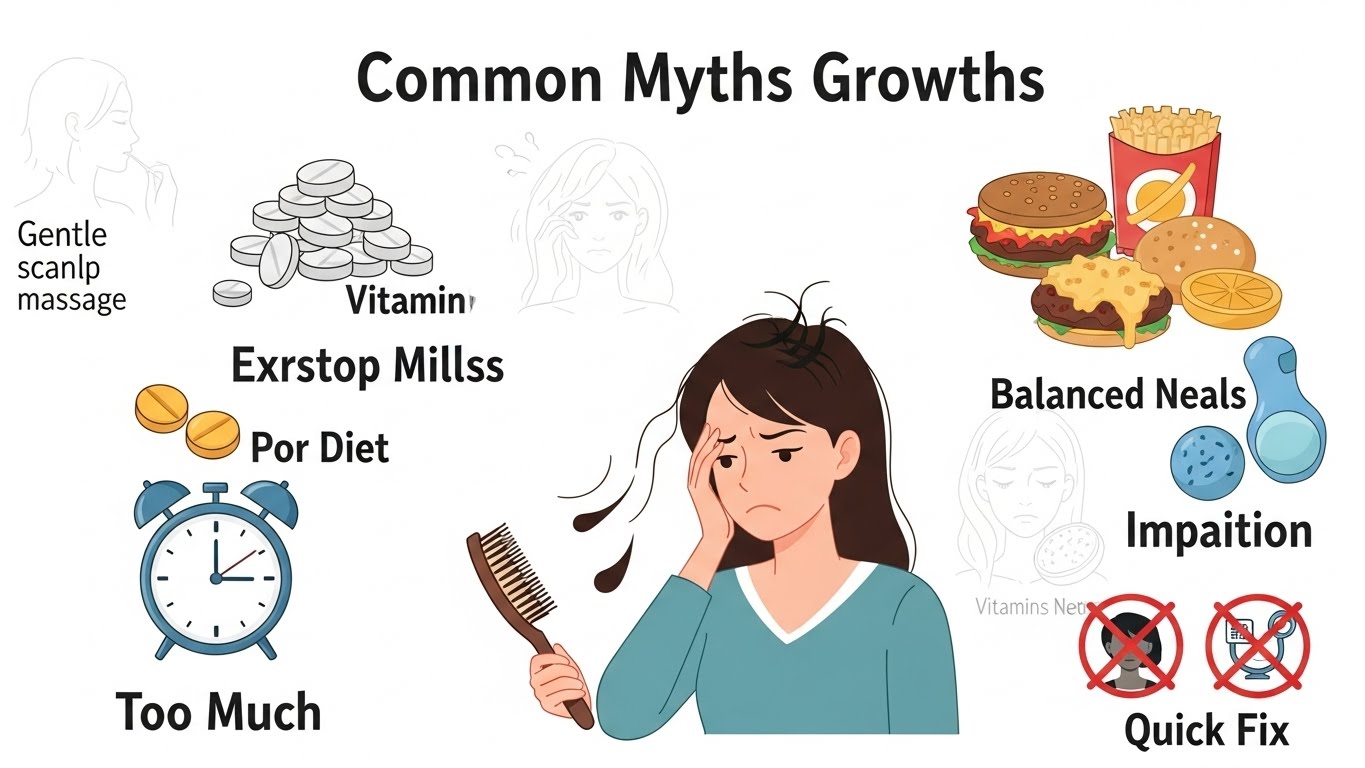
No supplement replaces a varied diet. The nutrients in this guide come from ordinary food: eggs, nuts, seeds and whole grains (biotin); oily fish and fortified foods (vitamin D); seeds, plant oils and nuts (vitamin E); sweet potatoes, carrots and leafy greens (vitamin A); citrus, berries and leafy greens (vitamin C); lean meat, beans and leafy greens (iron); lean meat, seeds and legumes (zinc). Protein matters too — hair is mostly keratin, a protein, and a very low-protein or crash diet can trigger shedding.
When to get help
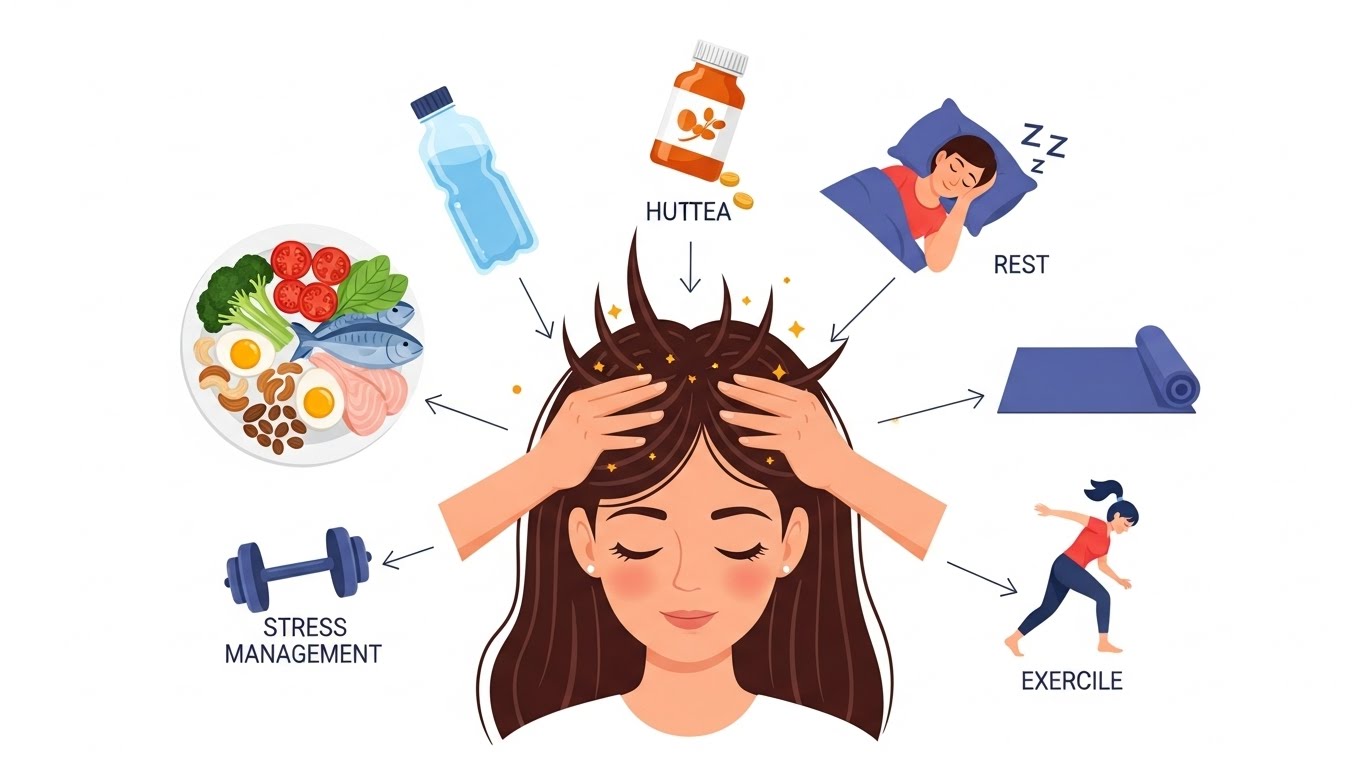
See a clinician or dermatologist if: your shedding is sudden or patchy; you have bald patches, itching, pain, scaling or redness; your hair has not regained normal fullness after a year; you are losing hair and do not know why; or you are considering a supplement and you are pregnant, breastfeeding, taking medication, or have a medical condition. The NHS advises seeing a GP before a commercial hair clinic, and notes that no treatment is 100% effective.
Summary
Supplements help hair only where a deficiency exists — test first, then supplement only what is low, with a clinician’s advice. Biotin has no good evidence in people who are not deficient, and high doses can interfere with heart-attack lab tests. Too much vitamin A can cause shedding. Iron and zinc should never be taken “just in case”. Pattern hair loss is not fixed by vitamins; its best-evidenced treatment is minoxidil, which takes 6–12 months to judge. Hair grows about a centimetre a month, so any real change takes months to show — and no product can promise a fixed result by a fixed date.
Sources: Almohanna et al. 2019; Patel et al. 2017; US FDA biotin safety communications (2017, updated 2019); 2021 iron meta-analysis; 2024 vitamin D systematic review and meta-analysis; NHS guidance on vitamin A and zinc; American Academy of Dermatology hair-loss and shedding guidance; NHS 111 Wales hair loss. This is a researched overview, not a hands-on review.