Researched overview.
Table Of Content
- Quick answer
- Why men’s hair thins
- The genetic and hormonal driver
- Other factors that can add to it
- What shampoo can and cannot do
- Ingredients with the best evidence
- Ingredients with weaker or preliminary evidence
- Choosing a formula
- Ingredients to be careful with
- How to wash
- Frequency and water temperature
- Application technique
- Scalp health beyond the shampoo bottle
- Diet, sleep and stress
- Common mistakes
- When to get help
- The bottom line
Quick answer
 Thinning hair in men is usually genetic — hair follicles that are sensitive to DHT, a hormone, shrink over time. No shampoo can cure that. What the right shampoo can do is keep the scalp healthy and reduce breakage, so the hair you have looks and feels better.
Of the ingredients found in shampoos, ketoconazole has the best — though still limited — evidence, and caffeine has weaker, mostly low-quality evidence. Saw palmetto and biotin have little to support them. The treatments with real evidence for pattern hair loss are minoxidil and finasteride, not shampoo.
If your hair loss is sudden, patchy, or comes with scalp pain, sores, or scarring, see a dermatologist or doctor first — shampoo is not the answer. This guide is general information, not medical advice.
Contents: Why men’s hair thins · What shampoo can and cannot do · Ingredients with the best evidence · Ingredients with weaker evidence · Choosing a formula · Ingredients to be careful with · How to wash · Scalp health · Diet, sleep and stress · Mistakes · When to get help
Why men’s hair thins
The genetic and hormonal driver
Male pattern hair loss is caused mainly by the hormone dihydrotestosterone (DHT), which over time causes genetically sensitive hair follicles to shrink, resulting in progressively finer, shorter hair. This is known as androgenetic alopecia, and it is responsible for the vast majority of hair loss in men, following a fairly predictable pattern — receding at the temples and then thinning at the crown.
Other factors that can add to it
Chronic stress, lack of sleep, and nutritional gaps do not usually cause pattern hair loss, but they can speed up visible thinning or trigger additional shedding on top of it. It is important to tell these apart: genetic hair loss responds very differently to treatment than stress-related shedding, which is usually temporary and reverses once the stress eases.
What shampoo can and cannot do
 No shampoo can halt genetically caused hair loss. What it can do is keep oil, product residue and dead skin from building up, keep the scalp healthy, and help existing hair break less.
Treat shampoo as scalp maintenance, not a hair regrowth treatment. The options that directly target the cause of hair loss are minoxidil (available over the counter) and finasteride (prescription-only — discuss the benefits and side effects with a doctor). Both are far more effective than any shampoo. Minoxidil takes time: results usually take 6–12 months, and some shedding at the start is common. Finasteride is a prescription medicine, not a cosmetic, and it is not suitable for everyone.
Ingredients with the best evidence
Ketoconazole. Ketoconazole is an antifungal used in dandruff shampoos. Its case for hair thinning rests mainly on one small 1998 trial (Piérard-Franchimont et al., 39 men with androgenetic alopecia): 2% ketoconazole shampoo used twice a week improved hair density and the proportion of growing follicles about as much as minoxidil 2% over 6 months. A 2020 systematic review (Fields et al.) called the evidence limited but directionally positive. That is the best evidence any shampoo ingredient has — and it is still small-trial evidence, never confirmed in a large trial. Ketoconazole is not approved for hair loss, and the well-studied 2% strength is prescription-only; over-the-counter versions are usually 1% and less studied for hair.
Caffeine. Caffeine can reach the hair follicle from a shampoo left on for about 2 minutes, and in laboratory studies it countered the growth-suppressing effect of testosterone on hair follicles (Fischer et al. 2007). In people, the evidence is weaker: the main trial (Dhurat et al. 2017, 210 men, 0.2% caffeine liquid vs minoxidil 5% over 6 months) found caffeine non-inferior to minoxidil on one measure — but it had no placebo group and nobody was blinded, so it cannot show whether either worked better than nothing. Systematic reviews in 2025 rated most caffeine trials as low or very low quality, and a Canadian expert panel did not recommend caffeine. Treat it as a plausible, low-risk extra — not a treatment.
Ingredients with weaker or preliminary evidence
Saw palmetto is often sold as a natural DHT blocker. A few small studies suggest it may have some mild effect, but the evidence is far weaker than for minoxidil or finasteride, and weaker than for ketoconazole.
Biotin is regularly found in hair-thinning shampoos, but it is mainly useful in cases of an actual biotin deficiency — for most men who are not deficient, extra biotin offers no significant benefit for hair thickness (Patel et al. 2017). High-dose biotin supplements can also interfere with laboratory tests, including the troponin test used to detect a heart attack — the FDA has warned about this.
Choosing a formula
For men with thin hair but not significant balding, a volumising formula is a reasonable option, since it helps hair appear fuller without heavy coating agents. Shampoos built around ketoconazole or caffeine may be more useful for men specifically concerned about thinning, while a basic, nourishing formula designed to minimise breakage is better suited to hair that is more fragile than thin.
| Shampoo type | Best for | Key ingredients | Consideration |
|---|---|---|---|
| Volumising | Fine, thin hair | Lightweight polymers | Doesn’t address the underlying cause of thinning |
| Thinning-focused | Genetic thinning | Ketoconazole, caffeine | Evidence is modest and small-trial; not a replacement for proven treatments |
| Strengthening | Fragile, breakage-prone hair | Biotin, protein-based conditioners | Best for hair health, not regrowth |
| Scalp-focused | Oily or congested scalp | Salicylic acid, tea tree | Addresses build-up rather than thinning directly |
No product is named or recommended here.
Ingredients to be careful with
Sulfates, especially sodium lauryl sulfate, are strong cleansers. Continued use can dry out some scalps and strip natural oils — but they are not “harmful” to hair as such, and many people use them without problems. If your scalp feels dry or tight after washing, a gentler, sulfate-free formula is worth trying.
Heavy silicones deposit on the hair shaft and can make already-fine hair appear even thinner. They do not damage the hair; they weigh it down.
Alcohol-based formulas can dry out hair and scalp — but check which alcohol: drying alcohols (alcohol denat, ethanol) are the problem, while fatty alcohols (cetyl alcohol, stearyl alcohol) are conditioning agents and are fine.
How to wash
Frequency and water temperature
Wash as often as your scalp needs it. There is no rule that suits everyone: an oily scalp may need daily washing, while a dry scalp may only need washing a few times a week. Over-washing with a strong formula can dry and irritate the scalp, but there is no good evidence that the scalp compensates by producing more oil — that claim is disputed, not proven. Use lukewarm water rather than hot, which dries the scalp out.
Application technique
Use gentle fingertips rather than nails or vigorous scrubbing to massage shampoo into the scalp. That avoids stress on already-fragile hair. A thorough rinse matters too, since leftover product residue can contribute to the same build-up a good shampoo is meant to prevent.
Before using a new shampoo, patch test it: put a small amount on the inside of your arm or the bend of your elbow, twice a day for 7 to 10 days. If the skin turns red or itchy, do not use it. (This is the American Academy of Dermatology patch-test method.)
Scalp health beyond the shampoo bottle
A congested scalp — full of excess oil, product, or dead skin — makes it harder for existing hair follicles to stay healthy. Gentle massage feels pleasant and is a harmless habit, but there is no good evidence that scalp massage grows hair (Koyama et al. 2016: 9 men, no control group). Some men find essential oils like rosemary or peppermint, diluted properly, soothing — but the evidence for growth is thin: rosemary oil’s case is a single small study against minoxidil 2% (Panahi et al. 2015), and peppermint oil has only been tested in mice (Oh et al. 2014).
A soft-bristle brush distributes natural oils along the hair shaft without unnecessary pulling. None of this replaces addressing the underlying cause of thinning, but it supports the health of the hair that is already there. The scalp is skin too — an exposed parting can sunburn, so use broad-spectrum SPF 30+ sunscreen on it, or cover it with a hat.
Diet, sleep and stress
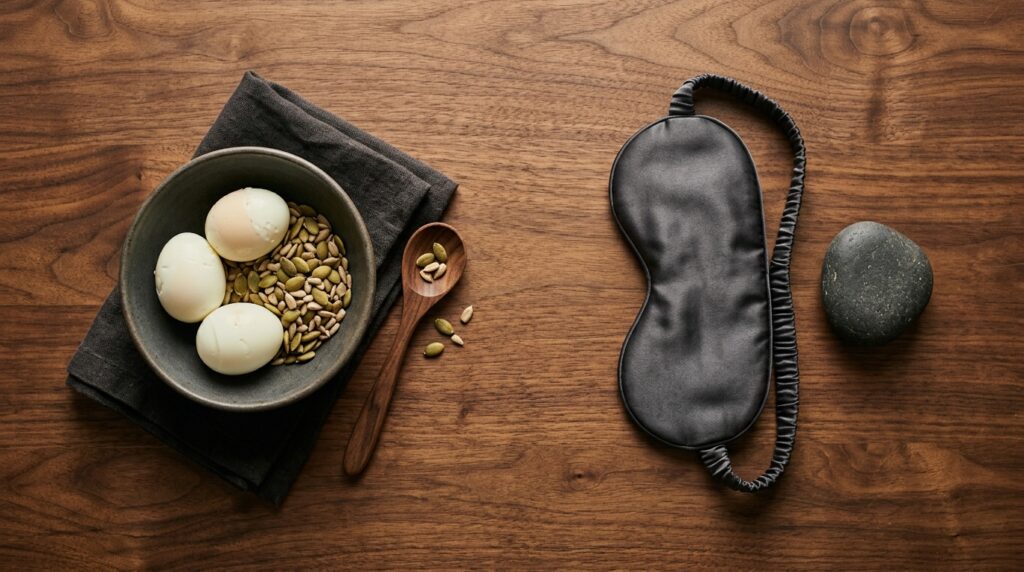 Human hair is made of protein, so adequate protein intake matters. Iron and zinc both play roles in follicle health, and a deficiency in either is linked to increased shedding — though supplementing beyond what is needed to correct an actual deficiency provides no added benefit. Do not take iron supplements without a blood test first: excess iron is harmful, and iron supplements are a common cause of accidental poisoning in children.
Chronic stress can push more hair follicles into a shedding phase than usual — a pattern called telogen effluvium, which usually starts 2–3 months after the trigger and is generally temporary and reversible once the stress eases, with fullness returning over 6–9 months. Sleep and stress management support hair health as a byproduct of supporting overall health; they do not directly regrow hair.
Common mistakes
- Switching shampoos too frequently — most ingredients need several weeks to months of consistent use before any effect becomes noticeable.
- Over-washing with strong formulas, which dries and irritates the scalp rather than helping thinning hair.
- Ignoring the scalp — focusing entirely on the visible hair while neglecting scalp health limits what even a good shampoo can do.
- Expecting shampoo alone to reverse genetic thinning — shampoo supports hair health but does not address the hormonal driver.
- Rough towel-drying or tight hairstyles — both contribute to unnecessary breakage in hair that is already more fragile than average.
- Chasing “natural” on the label — gentleness and effective ingredients matter more than whether a formula is marketed as natural. The FDA has never legally defined “natural” for cosmetics.
When to get help
See a dermatologist or doctor if: hair loss is sudden or patchy; you have scalp pain, sores, scarring or redness that does not settle; you are considering finasteride or any prescription treatment; or you are unsure whether a product is safe for you.
The bottom line
The best thinning-hair shampoos are built around ingredients with genuine evidence — ketoconazole has the best shampoo-level evidence, though it is still small-trial evidence, and caffeine is weaker still — paired with gentle washing habits and reasonable expectations about what a shampoo can actually accomplish. For genetic hair thinning specifically, shampoo works best as a supporting habit alongside evidence-based options like minoxidil, not as a standalone solution. Consistency, patience, and attention to the whole picture — sleep, diet, stress, and scalp care — tend to produce better results than chasing whatever product promises the fastest fix.
Sources: Piérard-Franchimont et al. 1998 on ketoconazole; Fields et al. 2020 systematic review; Fischer et al. 2007 and Dhurat et al. 2017 on caffeine; 2025 systematic reviews on caffeine; Patel et al. 2017 on biotin; Panahi et al. 2015 on rosemary oil; Oh et al. 2014 on peppermint oil (mice); Koyama et al. 2016 on scalp massage; AAD guidance on hair shedding and hair growth; FDA biotin lab-test warning. This is a researched overview, not a hands-on review.