Researched overview.
Table Of Content
- Quick answer
- Dry scalp vs. buildup — they feel alike but aren’t
- What scalp exfoliation actually does — and doesn’t do
- How often to exfoliate
- The actual technique
- Physical scrubs vs. chemical options
- Aftercare
- Everyday habits that support (or undermine) scalp health
- Adjusting the routine seasonally
- Dandruff: when it’s not just buildup
- When to see a doctor
- Summary
Quick answer
The scalp is skin. It sheds dead cells, makes oil, and collects sweat, dust and styling-product residue — the same way facial skin does. When that residue builds up around the hair follicles, the scalp can feel tight or itchy and flakes can show even right after washing.
Gentle exfoliation clears that surface debris so shampoo can actually reach the scalp. It does not force hair to grow, and it cannot override genetics or a diagnosed hair-loss condition. What it does is clear the way for healthier growth from follicles that are already working, by removing debris that irritates the scalp.
If your flakes are dandruff, exfoliation is not the treatment — a dandruff shampoo is. That distinction is in its own section below, because getting it wrong wastes weeks.
Contents: Dry scalp vs. buildup · What exfoliation does and doesn’t do · How often · Technique · Aftercare · Everyday habits · Dandruff: when it’s not just buildup · When to see a doctor
Dry scalp vs. buildup — they feel alike but aren’t
This distinction trips a lot of men up. A dry scalp lacks moisture. A scalp with buildup is coated in oil, dead skin and product residue. Both can feel tight or itchy, which is exactly why piling on more oil-based product when buildup is the real issue tends to make things worse rather than better.
A dry scalp generally responds to added hydration. A scalp with buildup responds to exfoliation first, and only light, non-comedogenic products after that.
A useful check: if your scalp feels tight and itchy but your hair looks visibly oily or product-coated, that points to buildup — try a gentle exfoliating step before adding another moisturising product. If the scalp feels dry and the hair looks dry too, with fine white flakes and no oily coating, hydration is the more likely answer. If you are not sure which it is, start with the gentlest option and watch how the scalp responds over two weeks.
What scalp exfoliation actually does — and doesn’t do
Exfoliation clears dead skin cells and surface debris from the scalp. That lets shampoo reach the skin at the root instead of sliding over a layer of residue, and it removes material that can irritate the scalp.
What it does not do:
- It does not make hair grow faster, and no exfoliation routine can override genetics or a diagnosed hair-loss condition.
- It does not “feed” the follicles. Hair follicles do not absorb moisture or product from the surface — exfoliation works by clearing debris, not by delivering nutrients into the follicle.
- It does not fix dandruff on its own. Dandruff is usually driven by yeast (seborrheic dermatitis), not by simple dryness, and it needs a medicated shampoo — see the dandruff section below.
How often to exfoliate
Frequency depends on scalp type and lifestyle. As a starting point:
| Scalp type | Start here |
|---|---|
| Oily scalp, or a lot of sweat, helmets or styling product | Once a week |
| Normal scalp | Once a week, or every two weeks |
| Dry or sensitive scalp | Once every two weeks, or less often |
Start on the low end for your scalp type and only increase if your scalp handles it without redness or extra sensitivity. The scalp needs recovery time between sessions, the same way skin elsewhere on the body does after exfoliating. Pushing frequency higher than your scalp tolerates tends to backfire into irritation rather than speeding up results.
One practical alternative some dermatologists use is to count washes rather than weeks — roughly once every 7 to 10 washes. That amounts to a similar range in practice. Treat it as a guide, not a rule: how your scalp feels matters more than the count.
The actual technique
Home scalp exfoliation doesn’t require harsh scrubs or aggressive tools — those tend to cause more harm than good.
- Work on slightly damp hair, not soaking wet and not bone dry. Damp hair is easier to part, so you can see and feel the scalp without it matting in the way. Exfoliate right before a wash, so the lifted debris rinses away in the same session.
- Trim fingernails short first. Long or sharp nails are one of the most common causes of irritation during scalp exfoliation — it is easy to scratch rather than gently lift debris.
- Use slow, circular fingertip motion, not scrubbing pressure. Keep the movement light and localised, working in small sections rather than dragging across the whole scalp at once. The goal is a scalp that feels clear afterward, not sore.
- Work in sections. Longer hair traps more oil and sweat close to the scalp, so dividing hair into sections helps make sure no area gets missed. Short hair or a shaved head exposes more of the scalp directly, so less product and lighter pressure generally go further.
Before using a new exfoliating product, patch test it: put a small amount on the inside of your arm or the bend of your elbow, twice a day for 7 to 10 days. If the skin turns red or itchy, do not use it. (This is the American Academy of Dermatology patch-test method.)
Physical scrubs vs. chemical options
| Option | Best for | How it works | Caution |
|---|---|---|---|
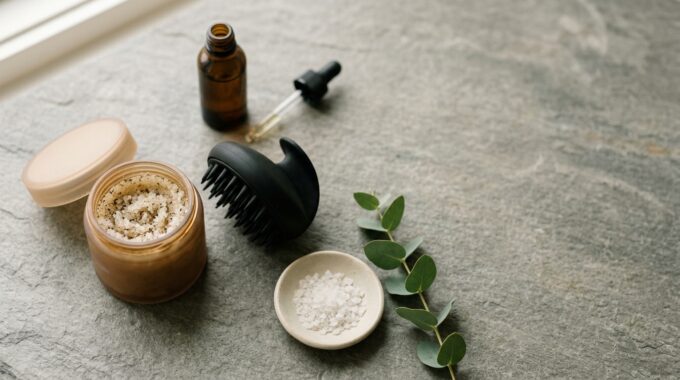
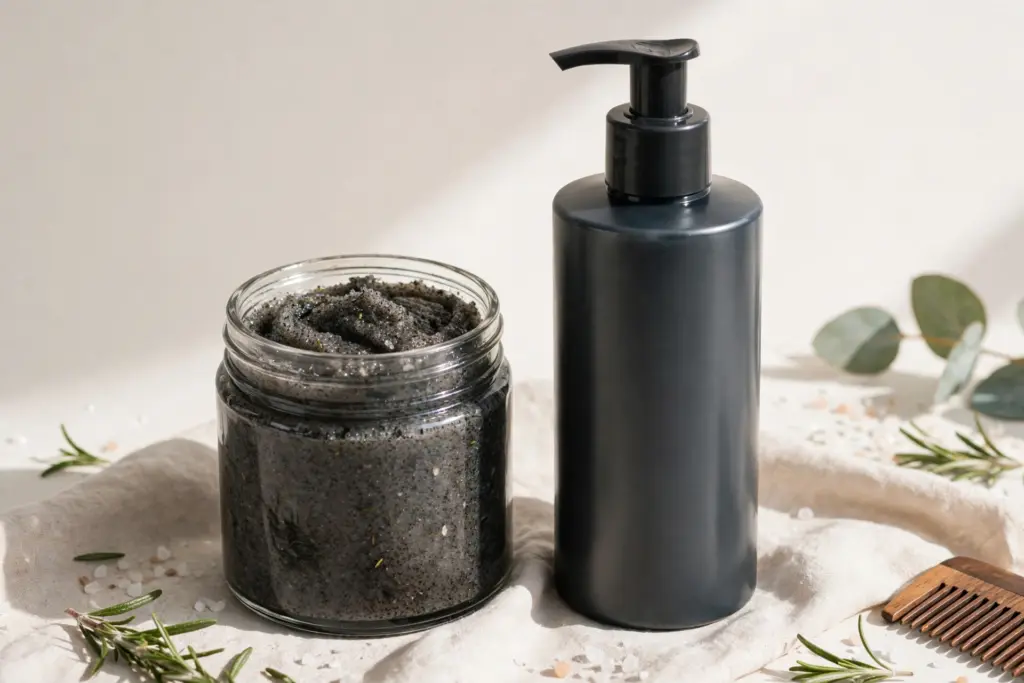
| Fine sugar or salt scrub | Oily, resilient scalps | Physical lifting of dead skin and buildup | Crystals can scratch irritated skin. Use once a week at most, only if the scalp tolerates it, and stop if it stings or flakes more afterward. Do not use on broken, sore or very red skin. |
| Oatmeal-based scrub | Sensitive or easily irritated scalps | Gentle physical exfoliation | Every two weeks at most. Stop if irritation appears. |
| Dandruff shampoo (salicylic acid, zinc pyrithione, selenium sulfide, ketoconazole or coal tar) | Dandruff-prone or flaky scalps | Dissolves scale and, for the antifungal actives, targets the yeast behind dandruff | Follow the bottle instructions. Some dandruff shampoos need to stay on the scalp for 5–10 minutes before rinsing. See the dandruff section below. |
| Light oil (jojoba, coconut) + fingertip massage | Dry or sensitive scalps needing gentler care | Softens debris before gentle lifting | Oil is a pre-step, not a treatment. It does not treat dandruff, and heavy oil can make some flaky scalps worse. |
If you use a new product, test it on a small area of scalp first and rinse with lukewarm rather than hot water — that reduces the risk of irritation. (Patch test any new product first, using the AAD 7–10 day method.)
Aftercare
What happens right after exfoliating is easy to skip, but it is part of what makes the results stick.
- Towel-dry gently rather than rubbing the scalp, since the skin is slightly more sensitive right after exfoliating. Air-drying is generally the safest option; if heat is used, keep it on the lowest setting.
- Keep products light afterward. A freshly exfoliated scalp takes up product more readily. Light, non-comedogenic products calm the skin, while heavy oils or creams applied too soon can sit on the very surface you just cleared. Give the scalp a short break before going back to heavier styling products.
- Back off if it reacts. A small amount of redness or mild tenderness right after exfoliating can be a normal, temporary response. Persistent redness, ongoing sensitivity or recurring flare-ups usually mean something in the routine needs to change — pressure, frequency or the product. When irritation shows up, stop exfoliating entirely for a week or two and let the scalp recover before trying again with a gentler approach. Pushing through discomfort tends to delay recovery rather than speed up results.
- Sun. A freshly exfoliated scalp is more sensitive to sun — the scalp is skin too, so use broad-spectrum SPF 30+ sunscreen on any exposed scalp or parting, or cover it with a hat.
Everyday habits that support (or undermine) scalp health
The bathroom routine is only part of the picture — daily habits outside of washing matter just as much.
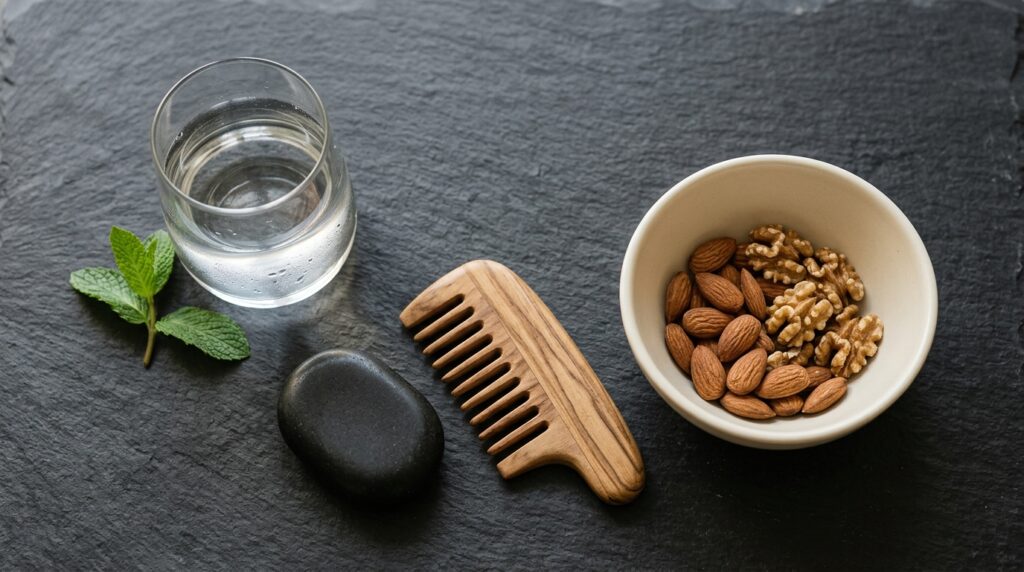
- Hats and helmets. Tight caps trap sweat against the scalp, and helmets add pressure that can push oil further into pores. Washing hats and helmet padding regularly, and letting hair breathe when possible, reduces how much residue builds up between washes.
- Sweat and activity. For men who train or work outdoors, sweat mixed with natural oil creates residue that clings over time. Showering soon after a workout, rather than letting sweat sit and dry, reduces how much salt and oil bonds to the scalp. Daily habits do more heavy lifting here than the exfoliation routine itself.
- Stress. Stress can show up as tension and itching, and chronic stress is linked to certain types of hair shedding (telogen effluvium), though it is rarely the sole cause. Slower breathing and general stress reduction are a legitimate supporting factor, not a replacement for the routine — and there is no good evidence that tight scalp muscles reduce circulation or disrupt oil distribution, so this guide does not claim that.
- Food and water. Eating well and drinking enough water support general health, including skin. But no food or drink is a treatment for a scalp problem, and no meal changes hair or scalp condition on a fixed timeline. If shedding or flaking is the real concern, the dandruff section and the doctor section below matter more than diet.
Adjusting the routine seasonally
Cold weather tends to dry out the scalp, while heat and humidity tend to increase oil — which means a fixed, year-round exfoliation schedule often doesn’t serve every season equally well. Ease off frequency in dry winter months and allow more recovery time; lean slightly more into cleansing during hot, humid months. Adjust to what the scalp is doing, not to a calendar.
Dandruff: when it’s not just buildup
Flakes that keep coming back despite gentle exfoliation are often dandruff, and dandruff is usually driven by yeast (seborrheic dermatitis) rather than simple dryness. That is why moisturiser alone doesn’t fix it, and why exfoliation alone doesn’t either.
The American Academy of Dermatology’s dandruff guidance is straightforward: choose a dandruff shampoo by its active ingredient, not by brand. Look for one of these on the label: zinc pyrithione, salicylic acid, sulfur, selenium sulfide, ketoconazole, or coal tar. If one shampoo doesn’t work, try alternating between dandruff shampoos with different active ingredients.
How to use it:
- Lather it onto the scalp, not just the hair lengths, and follow the bottle instructions. Some dandruff shampoos need to stay on the scalp for about 5–10 minutes before rinsing.
- Match frequency to hair type: fine or straight hair, or an oily scalp, can be washed often, with the dandruff shampoo about twice a week. Coarse, curly or coily hair can be washed when needed, with the dandruff shampoo about once a week if tolerated — apply it to the scalp only, since the active ingredients can dry the hair lengths.
- Give it a fair trial: the NHS advises using an anti-dandruff shampoo for a month to see if it helps, and trying more than one type if the first doesn’t work.
- Protect the scalp from the sun while using coal-tar shampoo, which can make the scalp more sensitive to UV.
Do not rely on oil to treat dandruff. Heavy oil can make some cases of seborrheic dermatitis worse.
When to see a doctor
A consistent routine handles most day-to-day scalp issues, but some problems need more than a product swap. See a doctor or dermatologist if:
- Flakes or itching have not improved after about a month of using an anti-dandruff shampoo as directed (the NHS rule).
- There is redness, bleeding, bumps or persistent pain.
- The scalp is very itchy, red or swollen.
- There are flaky, itchy patches on the face or other parts of the body.
- You notice hair thinning or loss alongside the flaking.
A dermatologist can rule out conditions that look like ordinary buildup but need targeted treatment — seborrheic dermatitis, scalp psoriasis, eczema, or a fungal infection. If symptoms don’t improve after a few weeks of consistent home care, that is generally the signal to stop self-treating and get it looked at.
Summary
The scalp is skin: it sheds, it makes oil, and it collects residue. Gentle exfoliation — light fingertip pressure, small sections, damp hair, frequency matched to scalp type — clears that residue so shampoo can reach the scalp. It does not force hair to grow. If the problem is dandruff, use a dandruff shampoo with a named active ingredient for a month, and see a doctor if it hasn’t improved. Start low, stay gentle, and let the scalp’s response — not a fixed schedule — decide the frequency.
Sources: AAD dandruff guidance; NHS dandruff guidance; AAD hair-washing and curly-hair guidance (as established in Batches 17–18). This is a researched overview, not a hands-on review.