Researched overview. This guide is based on published dermatology guidance, not on hands-on product testing by BeautyKob. No product in this guide was tested by us.
Table Of Content
- Quick answer
- Know your skin and hair first
- Morning routine: defence, not repair
- Evening routine: repair and renewal
- Hair care: strength and shine
- Patch test first
- Nutrition and hydration: what shows up from the inside
- Sleep, stress and movement
- Weekly and monthly boosters
- Setting realistic expectations
- Frequently asked questions
- The bottom line
Quick answer

A routine that lasts is a short one you can keep. Cleanse gently, moisturise, protect with sunscreen in the morning; cleanse, treat and moisturise in the evening; wash your hair as often as your scalp needs; sleep enough. That is most of it.
What lasts is not a product. It is the routine itself, done steadily for weeks and months. Small improvements — less dryness, smoother texture — can show up within a few weeks. Deeper changes, like stronger-feeling hair or less breakage, generally take a few months, because they depend on new growth. Nothing in this guide promises permanent results: skin and hair keep changing, and a routine works for as long as you keep it up.
Know your skin and hair first
A routine built for someone else’s skin may not work for yours. Start by finding out what you have.
Skin type. Wash your face with a gentle cleanser, pat it dry, and wait an hour without putting anything on it. If it feels tight and looks flaky, it leans dry. If it looks shiny all over, it leans oily. If the T-zone (forehead, nose, chin) is shiny and the cheeks feel normal or dry, it is combination. If it stings, turns red or reacts easily, it is sensitive. Most people are somewhere between these labels — the test is a starting point, not a diagnosis.
Hair and scalp. Hair texture (straight, wavy, curly, coily) and scalp condition (oily, dry, sensitive) both matter. An oily scalp usually needs washing more often; dry or curly hair usually needs washing less often, because it does not replace lost moisture easily. Itchiness, flaking or excess oil are signs the scalp needs attention before hair products can do their job.
Morning routine: defence, not repair
A morning routine is not meant to undo anything overnight. It prepares skin and hair for the day — sun, pollution, dust and sweat.
Cleanse gently. Lukewarm water and a mild cleanser. Hot water pulls more natural oil from the skin and can worsen dryness over time. A light foaming cleanser suits oily skin; a creamy, hydrating cleanser suits dry skin; a fragrance-free formula suits sensitive skin. The goal is clean, not stripped — if your skin feels tight after washing, the cleanser is probably too strong.
Toner is optional. If you use one, choose an alcohol-free formula. Toner does not fix skin pH or make other products absorb better in any meaningful way; at most it is a light hydrating step. Alcohol-based astringents can irritate, including oily or acne-prone skin, so they are best avoided.
Moisturise for barrier support. Moisturiser binds water and supports the skin’s natural barrier. This matters as much for oily skin as for dry skin. Lightweight gels suit oily and combination skin; richer creams suit dry or mature skin.
Daily sun protection. This is the step that protects everything else. The American Academy of Dermatology recommends a broad-spectrum sunscreen of SPF 30 or higher on all exposed skin every day, reapplied roughly every two hours during extended outdoor exposure, and after swimming or sweating. SPF 30 blocks about 97% of UVB rays. This holds on cloudy days and near windows, since UV rays pass through both. The amount dermatologists recommend for full-body coverage is about a shot glass’ worth (around one ounce) — most people apply far less than that, which is part of why sunburn still happens despite “protection”.
Evening routine: repair and renewal
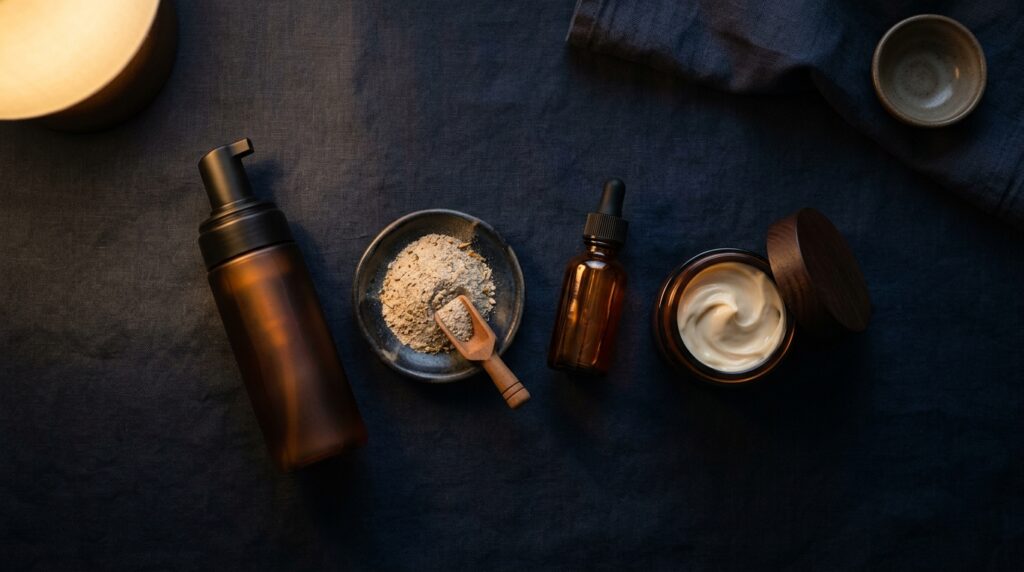
Evenings are for the heavier work: removing the day, exfoliating gently, and using active ingredients.
Cleanse more thoroughly at night. Make-up, sunscreen and pollution need to come off. A foaming cleanser suits oily or acne-prone skin at night; a creamy cleanser suits dry skin that should not be over-stripped before bed.
Exfoliate without overdoing it. Exfoliation clears dead skin cells and can leave skin more receptive to what follows. Most skin types do well exfoliating two or three times a week; sensitive skin usually does better with a gentle chemical exfoliant once or twice a week rather than a physical scrub. Exfoliating every night is not better — overdoing it damages the barrier and makes skin more reactive, not healthier.
Targeted serums and actives. Retinoids work best at night, because they increase sun sensitivity. They are the strongest topical ingredient for fine lines, but they take 3 to 6 months to show benefit, and they need to be introduced slowly — two or three nights a week, a pea-sized amount — building up only if your skin tolerates it. Do not use retinoids if you are pregnant or trying to become pregnant. Consistency matters more than potency: a product used only occasionally can irritate rather than help.
Night is a practical time for a richer routine — you are not layering sunscreen over it, and you are not wearing make-up. It is not a special biological repair window: skin renews itself all the time, day and night.
Night moisturiser. A richer cream with hyaluronic acid or ceramides helps reinforce the barrier and reduce water loss overnight. Oily skin types often skip this step, but a light moisturiser at night is still worth it.
Hair care: strength and shine
Wash and condition by need, not by schedule. Wash your hair according to how oily your scalp gets — oily scalps usually need washing two to three times a week, while dry or curly hair can go longer between washes. Conditioner smooths the cuticle and makes hair easier to comb, which is what reduces breakage. A weekly deep-conditioning treatment can make hair softer and easier to manage, but it does not repair damage: damaged hair cannot be repaired, and only trimming removes split ends.
Scalp care. A healthy scalp supports healthy hair. Scalp massage can feel pleasant, but there is no good evidence that it grows hair — the one often-cited study had nine men and no control group. Natural oils like coconut or jojoba can help with dryness and flaking as an occasional treatment. Coconut oil is the only oil shown to penetrate the hair shaft and reduce protein loss; it protects the shaft, it does not grow hair.
Heat and chemical protection. Heat styling and chemical treatments like colouring or relaxing weaken hair structurally over time. A heat protectant before styling, lower heat settings, and spacing out chemical treatments reduce cumulative damage. Wet hair is more fragile than dry hair, so detangle damp hair coated in conditioner, working from the ends upward with a wide-tooth comb — never brush dry hair to force out tangles.
Patch test first
Before you use a new product on your face or scalp, patch test it. Apply a small amount to a quarter-sized patch of skin on the inside of your arm or the bend of your elbow, twice a day, for 7 to 10 days. If there is redness, itching or swelling, do not use it on your face or scalp. This matters most the first time you use a product, or when you use a higher strength. A short test of a day or two can miss a reaction that takes several days to appear.
Nutrition and hydration: what shows up from the inside

Food supports general health, and general health shows in skin and hair. That is the honest version of the claim.
Water. Drinking enough water is essential for health, but there is no good evidence that drinking extra water makes skin more elastic or hair stronger. Drink when you are thirsty and keep a normal intake; water is not a skin treatment.
Protein and micronutrients. Hair and skin are largely protein-based, so a very low protein intake over time can show up as weaker hair and less resilient skin. Most people eating a normal varied diet get enough protein. Vitamin C supports collagen production in the body, vitamin A supports skin and scalp cell turnover, and zinc and iron deficiencies are linked to hair thinning and slow healing — but these nutrients only help when you are deficient. Taking more of them does not grow more hair. Biotin is vitamin B7; there is no good trial showing it helps hair in people who are not deficient, and high-dose biotin can interfere with a heart-attack lab test (troponin), so tell your doctor if you take it. Iron only helps hair when you are iron-deficient, and that needs a blood test first — do not take iron supplements without one. Zinc from food is fine; keep supplement intake below 25 mg a day, because excess zinc blocks copper absorption. Too much vitamin A can itself cause hair shedding.
Healthy fats. Fats from fish, nuts and seeds are part of a balanced diet and support the skin’s barrier from the inside, alongside — not instead of — topical moisturisers. Omega-3 supplements have not been shown to grow hair or treat skin.
No single food treats a skin or hair condition. Diet can support overall health; it is not a treatment.
Sleep, stress and movement
Sleep. Most adults need at least 7 hours of sleep a night. Sleep matters for skin: in a small study of 60 women, chronic poor sleepers had about double the signs of intrinsic skin ageing and slower skin-barrier recovery than good sleepers — but it was a small observational study, funded by the maker of a skincare brand, so it shows an association, not proof that poor sleep causes ageing. A smaller study of 24 women found that even one night without sleep measurably lowered skin hydration, impaired barrier function and reduced elasticity the next day — again a small study, and the changes were short-term measurements, not permanent damage. The practical point is simple: a bad night can make skin look dull the next morning, and steady sleep supports everything else. Growth hormone is released during deep sleep, as part of the body’s overnight maintenance.
Stress. Chronic stress is linked to breakouts and, through a pattern called telogen effluvium, to extra shedding two to three months after a stressful event, with fullness usually returning over six to nine months. That is a normal pattern, not a sign of permanent damage. Regular movement, sleep and a routine you can actually keep are the useful responses.
Habits worth dropping. Smoking and heavy alcohol use both accelerate skin ageing and compromise barrier function, working against whatever a topical routine is trying to achieve. Reducing unprotected sun exposure has a similar cumulative protective effect.
Weekly and monthly boosters
Daily care maintains skin and hair; weekly and monthly care fill gaps that daily steps do not reach.
| Booster | Frequency | What it does | Best for |
|---|---|---|---|
| Gentle exfoliating mask or peel | Once a week | Clears build-up on the surface | Dull or congested skin |
| Deep-conditioning hair mask | Once a week | Makes hair softer and easier to comb; does not repair damage | Heat-styled or chemically treated hair |
| Scalp oil treatment | Once or twice a month | Reduces dryness and flaking | Dry, tight or itchy scalp |
| Professional facial or consultation | Once a month | Adjusts the routine to changing needs | Persistent or seasonal skin issues |
Extras cannot replace daily care. A mask or a trim does not undo weeks of skipped sunscreen.
Setting realistic expectations
Small improvements — less dryness, smoother texture — tend to show up within a few weeks of consistent care. Deeper changes, like measurably stronger-feeling hair or reduced breakage, generally take a few months, since they depend on new growth and gradual change rather than any single treatment. Routines abandoned after a week or two rarely get far enough to show results, which is why consistency outperforms complexity. A simple routine you follow beats an elaborate one you abandon.
When to get help: see a clinician promptly if you have a rash, blisters or open sores; swelling that lasts more than a day or two; pain or vision changes near the eyes; a scalp that is very itchy, red or swollen; or hair shedding that is sudden, patchy, or does not settle after a few months. If skin or hair issues persist despite consistent care, a dermatologist can identify causes a routine alone will not fix.
Frequently asked questions
How long before I see a difference?
Small improvements like reduced dryness are often noticeable within a few weeks, while deeper changes such as improved hair strength or reduced breakage usually take two to three months of consistent care. There is no fixed week by which results appear, and no result is permanent — skin and hair keep changing.
Does a simple routine actually work as well as an elaborate one?
A simple, consistently followed routine generally outperforms a complex one that gets skipped or changed frequently. The number of products matters less than whether you actually use them, steadily, for weeks.
Do I need to change my skincare routine with the seasons?
Minor seasonal adjustments help — a richer moisturiser in winter, a lighter texture in summer. Major overhauls usually are not necessary; small tweaks to hydration and SPF use tend to be enough.
Does lack of sleep really affect skin and hair?
Yes, in the short term and probably in the long term too. Small studies have measured lower hydration and elasticity after a single night without sleep, and chronic poor sleep is associated with more signs of skin ageing. The evidence is small-scale and observational, so it is best read as a reason to protect sleep, not as a precise prediction.
What is the most common mistake people make with beauty routines?
Inconsistency — skipping steps, switching products too often, or abandoning a routine before it has had a few weeks to show effects. The second most common is skipping sunscreen, which undoes the rest of the routine.
The bottom line
A beauty routine that lasts is built on matching products to your actual skin and hair type, protecting skin with daily SPF, using active ingredients slowly and steadily, and backing all of it with sleep, hydration and nutrition — not on chasing the newest product. The visible payoff takes weeks for small changes and a few months for structural ones, and the routines that deliver results are the ones simple enough to actually keep up.
Sources: American Academy of Dermatology, 7 Rosacea skin care tips (patch-test method: apply a new product to a quarter-sized patch of skin on the inside of the arm for 7–10 days); American Academy of Dermatology, How to select anti-aging skin care products (broad-spectrum sunscreen, SPF 30 or higher, reapply every two hours outdoors). This is a researched overview, not a hands-on review.